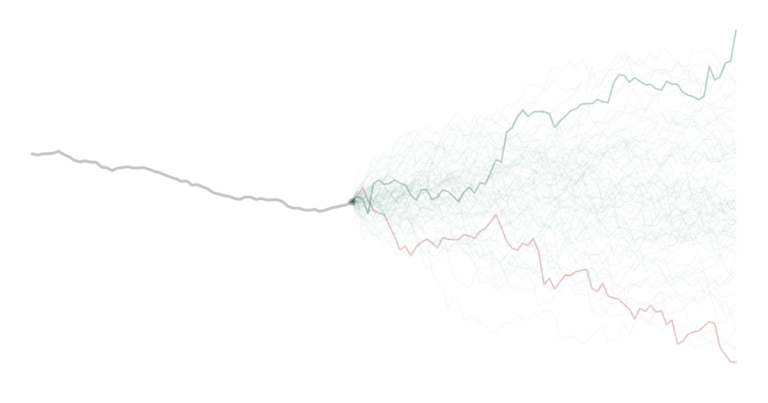


TL;DR: Retail investors spend hours comparing expense ratios and tax structures, and minutes evaluating how a fund actually invests. The fee-or-tax variable optimisation tops out at 2% a year. The difference between a good and bad investment process, measured by actual fund return spreads, is 4% to 15% a year. The attention allocation is inverted relative to where returns come from.
What investors obsess over Annual impact on returns Switching to a cheaper fund ~100 bps Choosing MF over PMS for tax efficiency 100–200 bps Picking a fund with a better process 400–1,500 bps bps = basis points. 100 bps = 1%.
An investor sits with two equity fund factsheets, comparing them line by line. Total expense ratio: 0.5% versus 1.4%. Exit load: nil versus 1% inside a year. Portfolio turnover: 22% versus 78%. The higher-turnover fund will trigger more short-term capital gains, so the tax drag is worse. The decision feels obvious. The cheaper, lower-turnover fund wins.
What never gets asked is what either fund actually does. How it decides what to buy. How it behaves when it is wrong. What kind of market it is built to survive. The investor has spent forty minutes reading the sticker price and zero minutes looking under the bonnet.
This is the legibility trap. It is one of the most expensive habits in retail investing in India, and almost no one names it.
What gets attention, and what does not
Fees and tax rates are legible. They are fixed numbers, printed on every factsheet, comparable across products, downloadable in a spreadsheet. The STCG rate is 20%. The LTCG rate above ₹1.25 lakh is 12.5%. A direct plan TER is lower than the regular plan TER by a known amount. Anyone can compare these. Anyone can optimise them.
An investment process is not legible. It requires judgement to evaluate. It needs time to observe across different market regimes. It cannot be reduced to a single number on a factsheet. Two funds with identical TERs, identical benchmarks, and identical category labels can have wildly different decision frameworks underneath, and the only way to tell is to look harder than most people are willing to.
So investors do what humans always do when faced with this kind of asymmetry. They optimise the part they can measure. This is the McNamara fallacy at work in a domain where the stakes are large and the feedback loop is slow. The behaviour is rational at the level of the individual decision and disastrous at the level of long-run outcomes.
The two fixations
Two specific versions of the trap show up over and over in Indian retail investing.
The first is STCG/LTCG threshold optimisation. An investor holds a deteriorating position for an extra two months to cross the one-year mark and pay LTCG instead of STCG. The tax saving is real and quantifiable. The opportunity cost of capital tied up in a losing position is also real, also quantifiable, and frequently larger than the tax saving. The fixation produces a clear number on the saving side and an invisible loss on the other. Only one side gets attention.
The second is the PMS-versus-mutual-fund tax drag debate that runs on fintwit. The argument: PMS investors own securities directly, so every portfolio churn creates an immediate taxable event. A mutual fund pools assets and defers the liability until redemption. That deferral has real value. Under realistic assumptions, the structural drag on a PMS portfolio is roughly 100 to 200 bps annualised compared to a mutual fund running a strategy with identical churn. This drag is real, but it is also being used as a deciding factor when it should be one input among several.
The math
Here is where the legibility trap gets expensive.
Across equity mutual funds. The S&P SPIVA India scorecard publishes quartile breakpoints by category, net of fees. As of mid-2025, the spread between the first-quartile and third-quartile breakpoints on five-year returns was roughly 200 bps for large-cap funds, 420 bps for ELSS, and 490 bps for mid-/small-cap funds. These are interquartile spreads, which understate the full dispersion. The gap between the median fund in the top quartile and the median fund in the bottom quartile is wider still.
Across PMS strategies. APMI data as of March 2026 shows the median five-year CAGR of top-quartile equity PMS strategies at around 19% and the median of the bottom quartile at around 6%, post fees and expenses. A spread of 1,300 bps annualised. These numbers carry survivorship bias, since strategies that shut down, typically at the lower end of returns, do not appear in the universe. Which means the true ex-ante dispersion was wider.
Across AIFs. PMS Bazaar’s FY2025 tracking found top-quartile long-short AIFs averaging 16.26% returns against bottom-quartile averaging 0.8%. A spread of roughly 1,550 bps in a single year.
Now compare what investors actually obsess over. Within mutual funds, the gap between the cheapest and most expensive product in a category is at most 150 bps. Across vehicles, the structural tax drag of PMS over mutual fund runs 100 to 200 bps. Whichever decision the investor is making, the fee-or-tax variable in play tops out at roughly 200 bps a year.
The process variable, measured by realised dispersion across the same asset class, is worth 400 to 1,500 bps a year depending on the segment.
The process variable is worth 400 to 1,500 bps a year. The fee-or-tax variable in play tops out at 200.
Fee optimisation also has a bounded payoff. The cheapest product in a category already charges what it charges, so the maximum benefit from picking on fees is the category’s TER spread. Process selection has no comparable ceiling. The legibility trap directs attention to the bounded decision because the math is simpler, not because the prize is bigger.
This is not an argument that fees do not matter. Other things equal, lower fees beat higher fees. A fee filter shifts your odds within a category. A process filter changes which side of the return dispersion you end up on.
What process evaluation actually looks like
Take a worked example. Two flexi-cap funds, both with five-year track records, both available to retail investors.
Fund A holds 25 stocks, with the top ten making up roughly 60% of the portfolio. Annual turnover is 15%. The factsheet describes the approach as “high-conviction, long-term, value-oriented.” The fund manager has been in place for nine years. In the 2020 drawdown the fund fell 38% against a benchmark drop of 32%, then recovered the loss in eleven months.
Fund B holds 65 stocks, with no position above 4%. Annual turnover is 90%. The factsheet describes the approach as “diversified, multi-cap, growth-at-reasonable-price.” The fund has had three managers in five years. In the 2020 drawdown the fund fell 30%, then recovered in seven months.
Both are flexi-cap funds. The TER gap between them is 25 bps. Most retail investors would compare the two on TER and category-average returns and stop there. Process evaluation asks different questions.
What are the actual decision rules? Fund A’s “value-oriented” language is consistent with a concentrated portfolio and low turnover, but the words alone are not the rule. The rule is in the holdings: if the top ten positions are companies trading at premium valuations because they compound at high rates, the actual process is quality-growth, not value, regardless of what the factsheet calls it. Fund B’s “growth-at-reasonable-price” with 90% turnover is doing something more momentum-led than the description suggests. The rule is visible in what the fund actually owns and how often it changes its mind, not in the brochure language.
What does the process do when it is wrong? Fund A’s 38% drawdown is deeper than the benchmark. That is the cost of concentration. The eleven-month recovery is the test. A concentrated process that recovers fast tells you the manager held positions through the drawdown rather than capitulating. Fund B’s shallower drawdown is the benefit of diversification, but three manager changes in five years complicates the story. Whoever ran the process during the drawdown is not running it now. The recovery does not belong to the current manager.
Is the stated process the actual process? Look at the holdings page and check effective behaviour against the description. A concentrated value fund with 60% of assets in expensive compounders is doing quality investing, not value. A diversified growth fund with 90% turnover is doing momentum. The label is marketing. The behaviour is process.
How does the process behave across regimes? Five years of returns include 2020 (sharp drawdown and recovery), 2021 (broad rally), 2022 (rotation away from growth), 2023-2024 (selective participation), and 2025 (recent correction). A process should show distinct behaviour in each regime, not the same return profile dressed differently. If a fund outperformed in 2021’s rally and again in 2022’s rotation, it is either genuinely flexible or you are looking at lucky timing. The interesting question is which.
Is the process consistent across time? This is separate from process quality and arguably matters more. A person who throws darts consistently will make money over a long enough horizon, because the variance averages out and the position sizing does the work. A fund manager who runs a coherent strategy in 2020, drifts to momentum in 2021 because momentum is working, switches to defensives in 2022 after the rotation has already happened, and rediscovers value in 2024 will not. The dart-thrower has worse decisions and better outcomes, because the dart-thrower stays consistent and the manager does not. Manager changes are the most visible source of process drift. Style drift inside the same manager’s tenure is harder to spot because the style may change with regime also, with correct timing.
None of this requires insider access. Mutual fund holdings are public. The drawdown profile is calculable from NAV history. The manager tenure is on the AMC website. Process evaluation is mostly a question of asking the right questions, not finding hidden information. For PMS/AIF, you need to get these out of a conversation with the fund manager, without just focusing on taxation and fees.
The investor who ends this exercise still has to make a judgement call. Fund A’s concentration may suit a patient investor with a ten-year horizon and tolerance for deeper drawdowns. Fund B’s diversification may suit someone uncomfortable with single-stock risk. Neither answer is forced by the data. But the judgement is now informed by something other than the TER.
This is the work fee comparison cannot do for you.
Strategy over structure
The point is not that fees and taxes do not matter. They do. Other things equal, lower fees beat higher fees and tax-efficient structures beat inefficient ones. The point is the attention allocation. Look at expenses and fees after you have understood what you are buying.
The discourse on retail investing in India is reinforcing the legibility trap, not breaking it. Every comparison article ranks funds by expense ratio. Every fintwit thread on PMS versus mutual funds runs the tax-drag math. Almost nothing in the public conversation teaches a retail investor what to look for when evaluating an investment process. That is the work that needs doing.
The structural advantages and disadvantages of different vehicles are real, but they are second priority. The first priority question is what is happening inside the vehicle. If the cook and the ingredients are good, the food will be good irrespective of the utensils used.
Sources:
Mutual fund quartile breakpoints and category dispersion: SPIVA India Mid-Year 2025 Scorecard, S&P Dow Jones Indices.
PMS five-year quartile median returns: APMI data, as of March 2026.
AIF FY2025 long-short category top-quartile and bottom-quartile averages: PMS Bazaar, From Highs to Headwinds: How AIFs Performed in FY2025.