

Bonus and split do the same thing to your holding. Same share count after, same price, same stake in the same company. They also do the same thing to your P&L, right up until you sell.
Then they diverge, by 8% of your position.
The number
You bought 1,000 shares at ₹100 in January 2023. They are ₹500 today, so a ₹5,00,000 position and a ₹4,00,000 gain.
The company decides to multiply its share count by ten. A 1:10 split turns each of your shares into ten. A bonus of nine free shares for every one held gets you to exactly the same place. Either way you end the week with 10,000 shares worth ₹50 each.
You sell everything the next day.
| 1:10 split | 9:1 bonus | |
|---|---|---|
| Shares after | 10,000 | 10,000 |
| Long-term gain | ₹4,00,000 | minus ₹50,000 |
| Short-term gain | nil | ₹4,50,000 |
| Total gain | ₹4,00,000 | ₹4,00,000 |
| Tax | ₹50,000 | ₹90,000 |
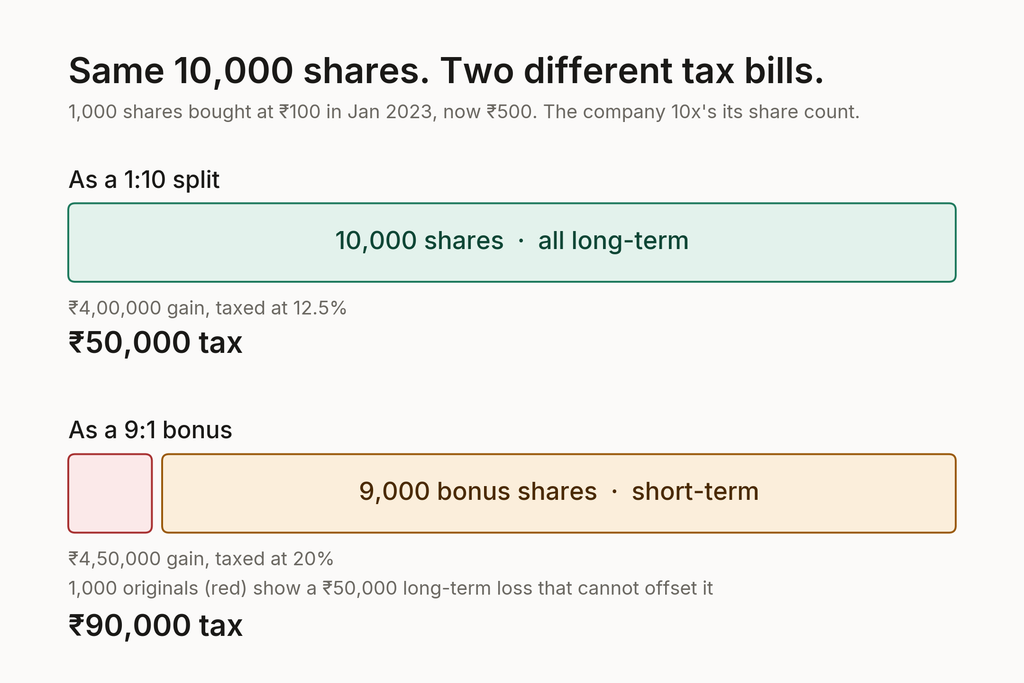
Your economic profit is ₹4,00,000 in both columns, because nothing about the business changed. Only the way that profit is carved up changed, and the carving costs you ₹40,000.
Long-term equity gains are taxed at 12.5%, short-term at 20%. These figures ignore the ₹1.25 lakh annual long-term exemption, which if you have it unused widens the gap rather than narrowing it.
Why the bonus costs more
Bonus shares are given to you. They are new shares that arrive free, and the law treats them as exactly that.
Their cost is zero, because you paid nothing for them. So every rupee they fetch when you sell is profit, with no purchase price to subtract.
And they are dated from the day they landed in your account, not from the day you bought the shares that earned them. That makes the profit short-term, taxed at 20% instead of 12.5%.
9000 of your 10000 shares are in that position.
Your original thousand are worse than no help. They cost ₹100 each and are worth ₹50 after the bonus, so they show a ₹50,000 long-term loss. A long-term loss cannot be set against a short-term gain, so it does nothing about the ₹90,000 you owe. It sits in your return waiting for some future long-term gain to absorb it.
A split does none of this, because nothing is given to you. Your existing shares are cut into smaller pieces. Your cost is spread across the larger number, and your purchase date does not move, because you never acquired anything. As far as tax is concerned, nothing happened.
The bit that runs backwards
You would assume a bonus costs you most when you are sitting on a big gain, since there is more long-term profit to lose. It works the other way round.
The amount a bonus pushes into the short-term bracket is set by the ex-price and the ratio. Here that is 9,000 shares at ₹50, so ₹4,50,000 of short-term gain and ₹90,000 of tax. Your purchase price is nowhere in that calculation. Whether you bought at ₹100 or at ₹450, the bonus produces the same ₹90,000 bill.
What your purchase price changes is the split figure it is being measured against, and that shrinks as your gain shrinks. So the gap widens.
Same stock, same ₹500 price, same action, varying only what you paid:
| You paid | Your gain | Split tax | Bonus tax | Gap |
|---|---|---|---|---|
| ₹50 | ₹4,50,000 | ₹56,250 | ₹90,000 | ₹33,750 |
| ₹100 | ₹4,00,000 | ₹50,000 | ₹90,000 | ₹40,000 |
| ₹200 | ₹3,00,000 | ₹37,500 | ₹90,000 | ₹52,500 |
| ₹300 | ₹2,00,000 | ₹25,000 | ₹90,000 | ₹65,000 |
| ₹450 | ₹50,000 | ₹6,250 | ₹90,000 | ₹83,750 |
The bonus column never moves.
The stranded loss grows as you go down the table too. At ₹200 your originals show a ₹1,50,000 long-term loss. At ₹450 it is ₹4,00,000. None of it touches the ₹90,000.
The bottom row is the one to sit with. You made ₹50,000, and the choice between two identical announcements is worth ₹83,750.
Selling before the ex-date
The obvious dodge is to sell before the bonus, book the whole gain as long-term, and buy back afterwards. It is legal. The anti-avoidance rules aimed at bonus issues cannot catch you, because you never receive any bonus shares.
If you were leaving anyway, do it. Selling 1,000 shares at ₹500 gives you ₹4,00,000 of long-term gain and a ₹50,000 bill instead of ₹90,000. That is the full ₹40,000 saved for the cost of one extra trade.
If you want to stay invested, it does nothing at all. Sell at ₹500, buy 10,000 shares back at ₹50, and you are exactly where the bonus would have put you. Say you sell at ₹60 a year later.
Hold through the bonus and your tax is ₹62,500, paid once at the end. Sell and buy back and it is ₹50,000 now plus ₹12,500 later. ₹62,500 either way, to the rupee.
That is not a coincidence. Selling early does not reduce your tax. It pulls the tax forward and raises your cost basis by exactly the same amount, and the two cancel out. Any saving that appears to show up is coming from somewhere else, usually an extra year’s ₹1.25 lakh exemption, which had nothing to do with the corporate action and was available to you regardless.
Against that you have paid tax years early, given up brokerage, STT and stamp duty on a round trip, and restarted the holding period on your entire position to escape a bonus that would have restarted it on nine tenths.
One trap if you try it. Buy back before the record date and you receive the bonus anyway. Having bought within three months of it, an anti-avoidance rule now applies: sell any of your original shares within nine months and the loss on them is disallowed and rolled into the cost of the bonus shares instead.
So why does anyone issue a bonus
If the split is free and the bonus costs shareholders money, the question answers itself badly. I do not have a good explanation, and the ones that suggest themselves fall apart.
SEBI sets a minimum face value of ₹1, so a company already there cannot split. That is a real constraint and it explains a slice of the data. It does not explain Reliance, at ₹10 face value, issuing three 1:1 bonuses since 2009 when three splits would have taken it to ₹1.25 without touching the floor. Or LIC, also at ₹10, issuing its first bonus in sixty-nine years this May and capitalising ₹6,325 crore of reserves to do it. Both could have split. Neither wanted to.
Splits being finite and bonuses repeatable sounds like an answer, until you notice nobody issues them fast enough. Boards being indifferent to shareholder tax might be true, especially when the government holds 96.5% of LIC and pays no capital gains. But indifference explains why nobody avoids the bonus. It does not explain the preference.
What is left is that the bonus is the harder thing to do. It eats free reserves, needs a special resolution, and often needs authorised capital raised, which is why Reliance took its own from ₹15,000 crore to ₹50,000 crore in 2024. A split needs none of that.
Which is possibly the point. Anyone can split. A bonus requires you to actually hold free reserves and to convert them permanently into share capital, out of reach of dividends and buybacks forever. A company without the reserves cannot fake it. That makes a bonus capable of carrying information a split never can.
Or it is just habit. Splits were not available in India until SEBI abolished standard par value in 1999, and practices that old do not need a reason to persist. Two examples cannot separate the two stories, and both predict what we see. If the signalling account is right, bonus issuers should show higher free reserves against paid-up capital than split issuers at announcement. That’s something which needs to be checked.
The odd part
The law spells out what happens to bonus shares. Zero cost, fresh date, in black and white. It says nothing at all about splits.
The list of situations where your holding period restarts runs through mergers, demergers, liquidations, rights you chose not to take up. Sub-division is not on it and never has been. The cost side is dealt with separately, and it says a subdivided share’s cost comes from the original share it came out of, which only makes sense if the two are the same asset carrying on.
That reading is settled and brokers apply it. But notice the shape of it.
A bonus leaves your original shares alone. Same line, same date, untouched. Only the new shares are fresh, so your exposure is capped and you know exactly what it is.
A split wipes the original line out. The face value changes, the ISIN changes, and every share in your account is credited on the split date. Nothing survives carrying the old date. If the holding period were ever read the other way, you would not lose part of your position to short-term treatment. You would lose all of it.
What to do about it
Not much, and it would be dishonest to pretend otherwise.
Splits need no action. Your whole holding keeps its original date. If your holdings page looks strange for a couple of weeks after a split, zero-cost lots or part of the position tagged short-term, that is the display catching up rather than your tax position. Brokers apply corporate action adjustments by hand once the exchanges publish the details. If it still looks wrong a month later, ask, and ask about the tax report rather than the holdings screen.
Bonuses cost real money but only for a while. Twelve months after allotment the bonus shares go long-term and the problem disappears. It only bites if you exit inside that window, and if you are trimming rather than liquidating, your oldest shares go first, so the free ones sit at the back of the queue ageing quietly.
Where it matters is a full exit planned within a year of a bonus record date, on a holding that is not deeply in profit. Look at the second table. That is where the difference between selling now and waiting a few months runs into real money.
None of which makes the underlying thing less odd. Two corporate actions that are indistinguishable in substance, and the tax code reads one as a gift of new property and the other as a change of denomination!
General information, not tax advice. Talk to your tax adviser about your own position.