


Every few weeks, a famous investor explains how they got rich. Borrowed early. Put nearly everything into one idea. Held through a terrifying fall. Ignored everyone who told them to diversify.
It’s a good story. The problem is who isn’t telling it.
Thousands of people in India did exactly the same things in the same years. Borrowed against their holdings, went all-in on a company they were certain about, held through the drawdown. Most of them are not on podcasts. They went back to their jobs, or never recovered, or quietly stopped talking about the market.
You have never heard from a single one of them. Not because their stories are less instructive, but because nobody interviews them.
The uncomfortable bit
You’re not looking at a group of people who made good decisions. You’re looking at the survivors of a large group of people who made the same decision.
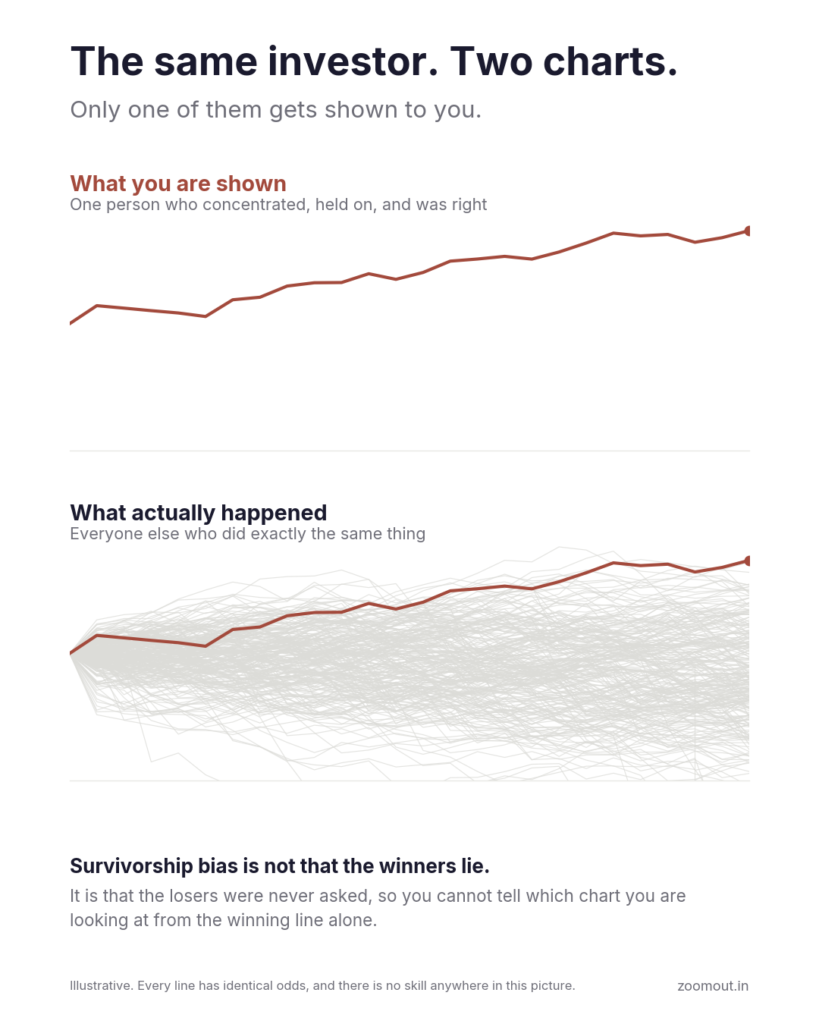
Some of them were genuinely brilliant. But you can’t tell which, and neither can they, because “it worked out” is exactly what luck looks like from the inside. Anyone who bet big and won will remember it as conviction. Anyone who bet big and lost remembers it as a mistake.
So when you copy the behaviour, you’re not copying a method that works. You’re copying a method that worked this time, for this person, and you’re only being shown the times it worked.
There’s a second problem. Where the skill was real, it was usually a specific kind: knowing things the market didn’t. In the eighties and nineties, annual reports arrived by post, management access was a phone call for the well-connected and a wall for everyone else, and a price could take months to catch up to information a diligent person already had. Concentrating hard made sense when you genuinely knew something. Today the filings are instant and public and the coverage is deep. The gap they were exploiting has mostly closed, so copying the aggressive position sizing without the edge that justified it leaves you with all of the risk and none of the reason for taking it.
Two things that get bundled together
Concentration. Putting most of your money in a few names. Get it wrong and you lose a lot of money and several years, but you’re still in the game. Painful. Survivable.
Leverage. Buying with borrowed money. Get it wrong and it’s over. Moreover, you don’t even have to be wrong. You can be completely right about a company and still be margin called out during a fall that reverses six months later. The lender doesn’t wait to find out whether you had a point.
These arrive together in every origin story, as one heroic package called “backing yourself.” They are not the same risk and they don’t deserve the same answer.
What the numbers we do have say
SEBI has actually counted one version of this. Of individual traders in equity derivatives, 93% lost money over three years. Only 7.2% made any profit at all, and just 1% made more than a lakh after costs.
That 1% exists. They’re real, they have real stories, and some of them will tell you what they did. Nothing they say is a lie. It’s just that 99 people did something similar and you’ll never meet them.
Mutual funds show the gentler version. Over ten years, 73% of Indian large-cap funds and 82% of mid and small-cap funds failed to beat their benchmark, and roughly 30% of funds shut down along the way, so even that flatters the survivors. The ones that beat the market rarely keep doing it.
What to actually do with the stories
Enjoy them. Learn what the person was thinking, what they looked for, how they handled being down. That’s genuinely useful.
Just don’t treat the size of their fortune as proof the method works, and ask three things before you copy anything:
What would the failed version of this person look like? If you can’t picture them, you’re seeing half the evidence.
Is this advice to concentrate, or advice to borrow? Take the first seriously. Treat the second as a completely different conversation.
Could I survive being wrong about this for five years? The famous investors could. That’s usually the part of the story that gets left out: the salary, the family money, the age, the fallback. Conviction is a lot cheaper when losing doesn’t end you.
Everyone who blew up was confident too. Confidence was never the thing that separated them.
Sources: SEBI studies on individual traders in the equity derivatives segment (a negative-sum market, unlike long-term equity investing); S&P Dow Jones SPIVA India Scorecard.